
What an Antioch Resident Lookup Can Confirm
The first step in an Antioch resident lookup is choosing a source that can answer the question. Property and deed records concern ownership or recorded interests. A voter-status check concerns a known person’s registration. Court records show parties and case events. Vital records establish events only through the eligibility rules for the requested copy. Business, license, unclaimed-property, newspaper, and directory results are association clues that need a second source.
| Record | What It Confirms | Where | Access |
|---|---|---|---|
| Assessment roll or deed | Ownership, tax-mail destination, transaction parties | Assessor counter and Clerk-Recorder | APN/address online; owner counter and index; copies paid |
| Voter registration | Individualized registration status and district | California SOS and Contra Costa Elections | Authenticated status; bulk access requires permitted use |
| Court index | Names, roles, case chronology, affiliations | Contra Costa Public Portal | Some documents free; exclusions and counter files |
| Vital record or index | Birth, death, marriage, and family links | County, CDPH, and historical indexes | Eligibility restrictions for certified copies |
| Business or license record | Entity role, credential, agent, or public address | SOS bizfile and DCA | Free public indexes; scope varies |
| Newspaper, directory, or obituary | Past residence, spouse, occupation, or life event | Contra Costa Library and history centers | Mixed online, card, film, paper, or in-person access |
Start with the source closest to the known fact. A name plus court date calls for the court portal. A name plus an old street calls for the library and parcel trail. A possible heir belongs in probate and obituary records, not a guess based on a similar surname.
Build a Two-Source Antioch Resident Match
Names collide. Normalize initials, hyphens, suffixes, former surnames, and common transliterations before searching. Then require two independent facts, such as a middle name, co-party, spouse, parcel legal description, occupation, license, or timeline. A first and last name alone is not enough to merge records in an Antioch resident lookup.
Separate the roles in the record. A deed proves a recorded interest at a time. A tax mailing address is a notice destination. A business agent address may be a service location. A court allegation is not a finding, and a case status or disposition matters. A newspaper relationship name is family-supplied until confirmed by vital or probate material.
- Same-name trap
- Two people share a name but differ in date, role, address, co-party, or record number.
- Situs address
- The physical parcel location, which may differ from the owner’s mailing address.
- Disposition
- The recorded outcome or status of a court matter, distinct from a filed allegation.
- Index
- A finding aid that points to a record; it may not include the full image or certified copy.
When the name is common, search a wider date range only after recording the first plausible match. A narrow query with the right role is safer than a large result set with no identity check.
Read an Antioch Court Record
Contra Costa Superior Court has no single statewide trial-court party index behind it, so an Antioch resident lookup begins with the county Public Portal and the assigned filing location. Antioch ZIP codes 94509 and 94531 route to Richard E. Arnason Justice Center, 1000 Center Drive, Pittsburg. Building hours are Monday through Friday, 8 to 5; filing windows run 8 to 4; phones are answered 8 to 3.
The court search can use case number, party or business name, first and last name, case type, and filing-date range. Name variants and a date range help separate people with common names. The visible result may contain case number, caption, case type and status, filing date, party names and roles, judicial officer or department, hearings, register-of-actions events, minutes, and public documents.
| Case number | Best exact identifier when known |
|---|---|
| Party or business name | Alternative search; narrow common names with dates and case type |
| First and last name | Party-name mode may split the fields |
| Case type | Civil, probate, small claims, and other enabled categories |
| Filing date range | Useful for separating similar names |
Civil documents filed after November 13, 2007 may be viewable when the case and category qualify. Probate web access may show a register but require Court Records for documents. Limited unlawful-detainer matters are not online. Older physical files can require about ten business days for off-site retrieval and picture ID for viewing.
Open the Contra Costa court online-services page before assuming that an empty result is a clean negative.
The Contra Costa traffic portal supplies the traffic search shown below.
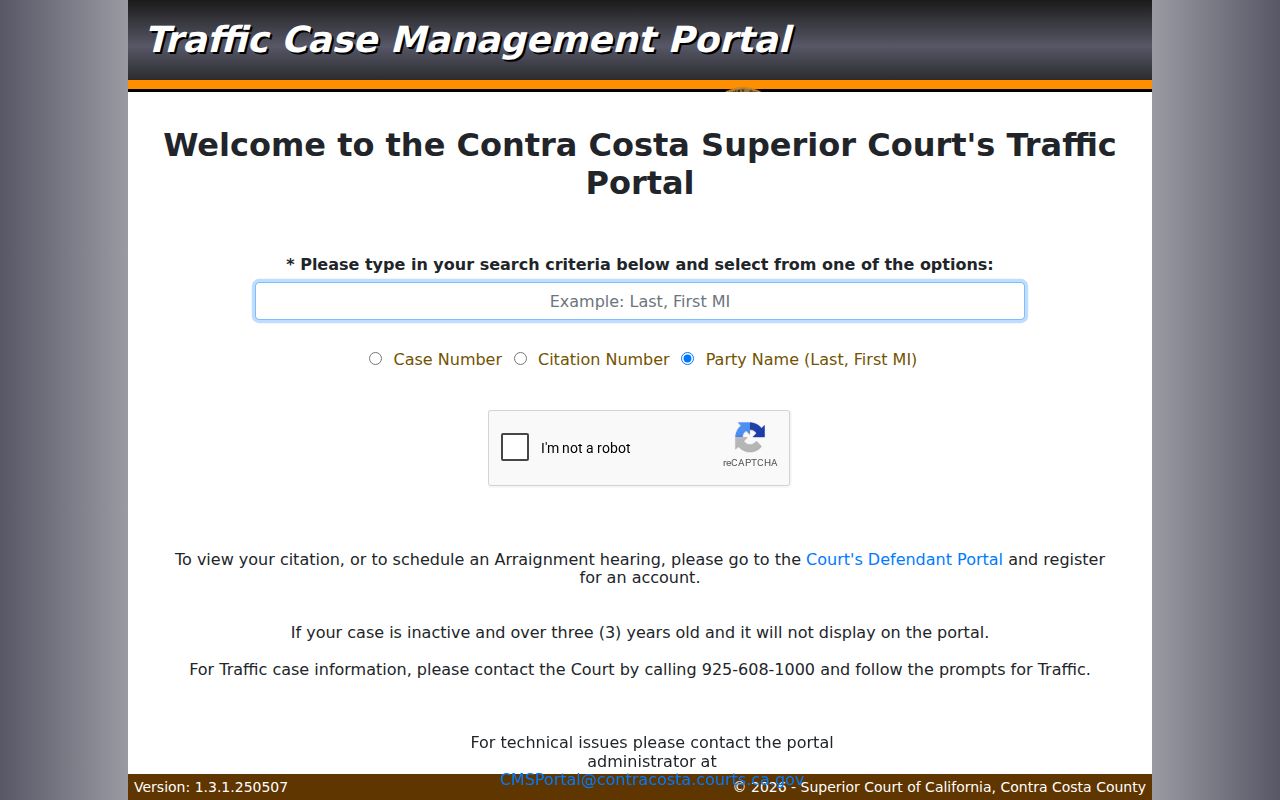
The traffic portal adds case-number, citation-number, and party-name routes. Inactive matters over three years old do not display, so portal scope and retention belong in the interpretation.
Note: A traffic result can identify a case path without proving a current address or a final outcome.
Antioch Vital Records Need the Right Copy
California vital records are not opened by a simple general age rule. The key distinction is between an authorized certified copy and an informational copy. Health and Safety Code sections 103526 and 103526.5 define eligible recipients. An informational copy carries a statement that it cannot establish identity. Confidential marriage records remain restricted under Family Code section 509.
Note: An informational certified copy is not an identity document, even when the underlying event is public.
Contra Costa Health Vital Registration at 10 Douglas Drive, Suite 220, Martinez, 925-313-1125, handles births and deaths in the current and immediately preceding calendar year through online, mail, and in-person channels. Older events shift to the Clerk-Recorder. County and CDPH requests can require registrant, event date and place, parents or spouses, relationship, copy type, sworn statement, signature, payment, and delivery details. Authorized mail orders add a notarized sworn statement.
CDPH’s statewide route is linked through California Vital Records. Fees recorded for January 1, 2026 are $31 for birth, $26 for death, $19 for marriage, and $18 for a dissolution certificate, with separate fetal-death and stillbirth amounts. Verify the live order page before payment. FamilySearch’s California County Birth and Death Records collection explicitly excludes Contra Costa, so it should not be presented as a county register image source.
A certified copy is a custodian-issued copy for an eligible requester. An index entry is a finding clue. Keep those two steps separate when a resident lookup depends on a birth, death, marriage, or divorce event.
Verify One Antioch Resident Step by Step
A focused Antioch resident lookup should move from a location-bearing clue to a second record, then to a custodian copy only if needed. This sequence reduces same-name errors without treating any single record as a complete biography.
- Anchor the name to an address, parcel, business filing, license, or court role. Because owner names are offline in the property tools, use the assessor counter when property ownership is plausible.
- Run the Contra Costa party search with name variants, date range, case type, and co-party or case number when available. Read status and disposition, not just the caption.
- Compare an independent fact, such as a spouse, middle name, license, parcel description, occupation, or newspaper date. Do not merge records on first and last name alone.
- Use the proper vital, probate, or court copy route when the index suggests a record. Confirm eligibility, fee, ID, notarization, and delivery rules with the custodian.
- Record what remains unknown. A deed can show ownership, while a voter check can show status and a directory can show an older subscriber.
- Docket
- The court’s chronological list of filings, events, hearings, and entries in a case.
- Index versus image
- An index points to a record; an image or certified copy supplies the underlying document, subject to access limits.
- Certified copy
- A copy issued or authenticated by the custodian for an eligible request.
- Chain of title
- The sequence of recorded interests linking one parcel holder to an earlier holder.
A good verification note names the source, query date, record number, role, and fact that matched. That habit makes later correction possible.
Antioch Voter Status for a Known Resident
California My Voter Status is not a browseable resident directory. It asks for first name, last name, date of birth, and sometimes California driver license or ID information or Social Security number digits. The result can include registration status, party preference, polling place or vote center, districts, and ballot status, depending on the election and supplied identity.
Election Code sections 2194 and 2188 limit how voter information may be obtained and used. A qualified full-file request requires requester identity, organization and purpose, requested jurisdiction, fields, format, certification, signature, and payment. Protected addresses, signatures, identification numbers, and Safe at Home information stay confidential. A registration status does not prove who else lives at an address or when an inactive voter moved.
Use the California Secretary of State voter-status tool only for a known person and the purpose allowed by the official flow.
Probate and Obituaries for Antioch Residents
A family-history resident lookup often ends where a current address search begins: probate, obituary, and newspaper records. A probate register or petition may identify heirs and notice addresses, but the actual documents come from Court Records and eligibility or copy rules apply. An obituary can connect relatives and a former address, but it is family-supplied evidence that deserves vital or probate corroboration.
For a birth parent or adoptee, California’s official adoption-information and intermediary processes are the lawful route. Adoption files are confidential and are not ordinary public name searches. For a former classmate, Antioch Historical Museum yearbooks from 1956 onward, earlier graduation photographs, newspapers, and telephone books can provide a time-bounded clue.
When a search concerns an heir, preserve the exact relationship language, date, newspaper title, and address. Then compare the clue with a deed, court register, or certified vital record rather than inferring family ties from a surname.
Antioch Business and License Records
California business and license indexes can resolve a name without claiming that the result is a residence. Bizfile Online searches entity name or file number and can show entity number, status, jurisdiction, agent, address, filings, and Statement of Information timing. The DCA search supports license type, number, business name, first name, last name, city, county, status, discipline, and public documents.
The State Controller’s unclaimed-property search accepts owner surname, given name, business name, or property ID. Results can show a reported name, address or city, reporting company, and property type. A claim requires proof and the result is an older financial association, not a current Antioch address. Pair it with a dated deed, court role, or newspaper clue.
Search the official California unclaimed-property portal when that narrow clue fits.
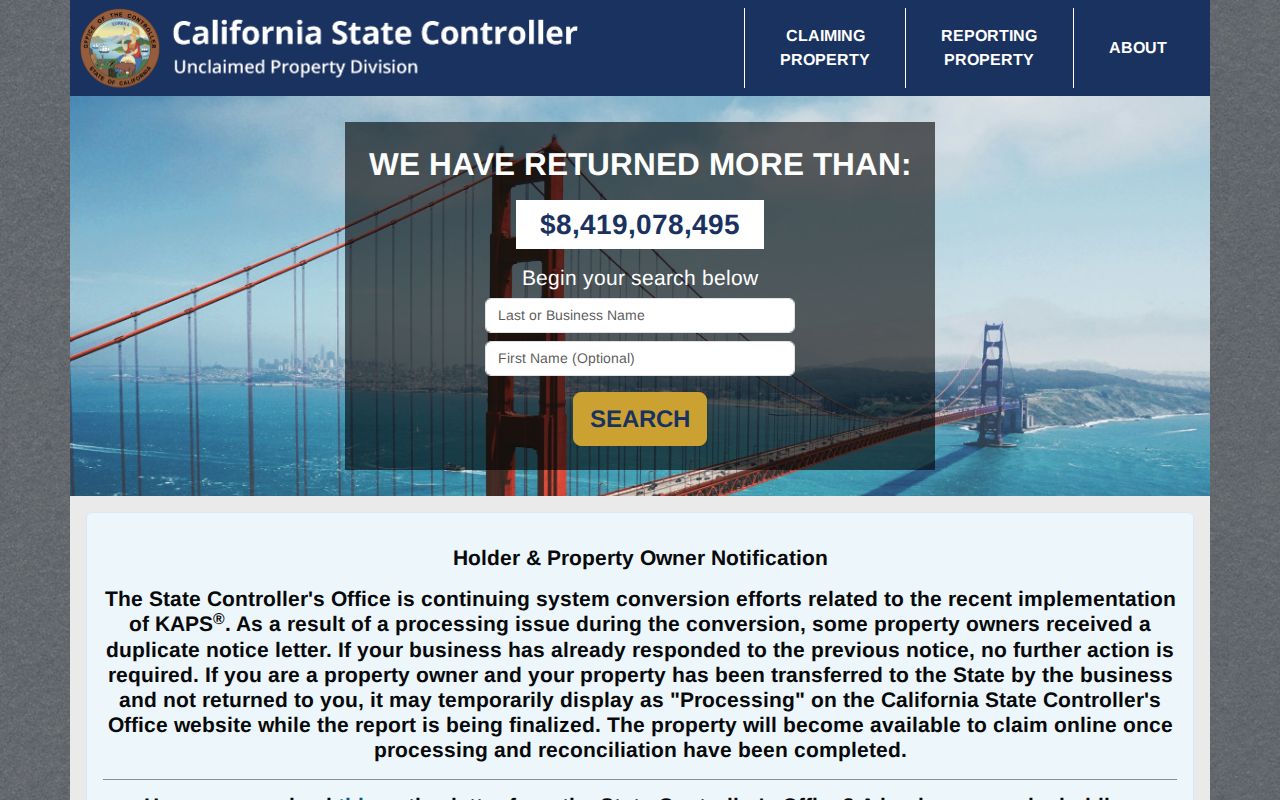
The claim workflow demonstrates why a public name match still needs a separate identity check and proof process.
Note: An unclaimed-property result is an older financial association, not proof of a current Antioch residence.
Antioch State and Federal Resident Searches
Law-enforcement and court tools can answer a specific status question, not supply a household directory. The Contra Costa Sheriff inmate locator may show custody and booking information as provided. The California CDCR locator can show name, age, CDCR number, location, admission date, commitment county, and parole-eligible date. A booking is not a conviction, and status can change.
Megan’s Law permits name and map searches for registrant information authorized for publication, with statutory warnings and exclusions. The federal Northern District of California uses PACER for case and docket searches. PACER charges $0.10 per page with a $3 cap for most documents and waives fees when quarterly use is $30 or less under current policy. Sealed material remains unavailable.
Use the official PACER access route when the federal court question is specific.
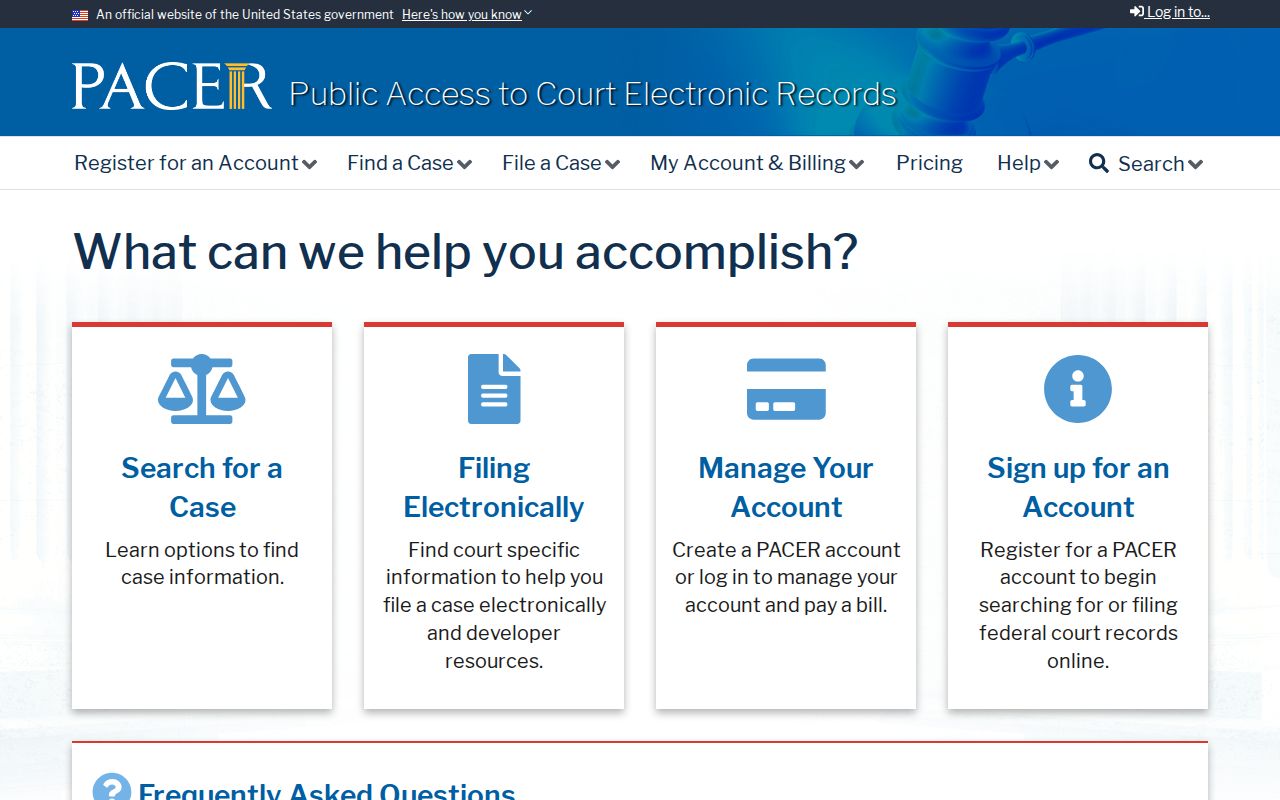
A federal case role, facility record, or registry result must not be recast as proof of current residence or guilt.
California’s Megan’s Law registry separately illustrates how a published result can carry a statutory-use warning.
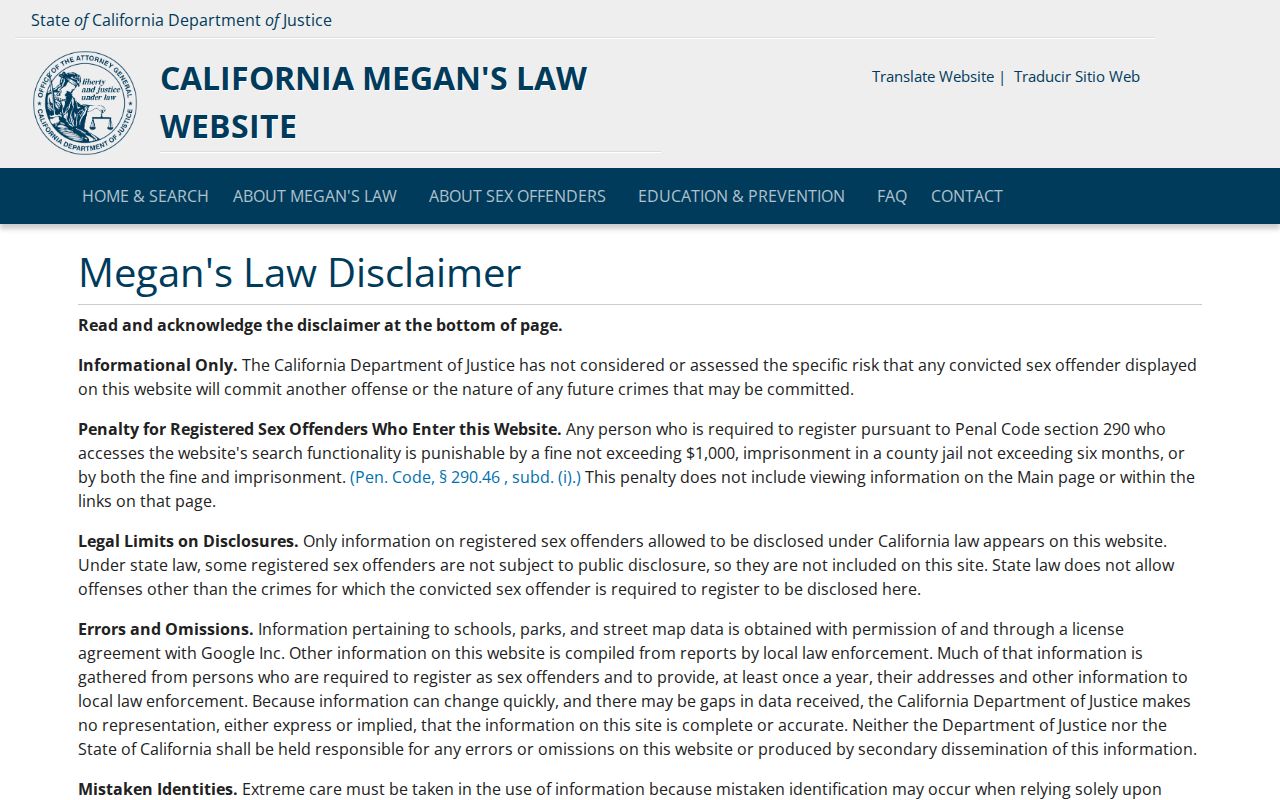
Use only the details the official system publishes and keep the warning with the result.
Legal Limits on an Antioch Resident Lookup
Safe at Home supplies a substitute mailing address for eligible survivors of domestic violence, stalking, sexual assault, human trafficking, elder or dependent-adult abuse, and certain reproductive-health workers, patients, and volunteers. Public sources must not be combined to defeat the program. California also protects specified officials and confidential fields, while sealed, juvenile, adoption, and confidential family information can stay outside a public result.
Lawful personal use. An Antioch resident lookup is for personal, family-history, civic, or safety research. Public availability does not authorize stalking, threats, repeated unwanted contact, trespass, or harassment.
California’s Consumer Privacy Act, as amended by CPRA, gives covered-business consumers rights to know, delete, correct, limit use or disclosure of sensitive information, and opt out of sale or sharing. The free DROP system can send a verified deletion or no-sale request to registered data brokers, but deletion from a broker does not rewrite a deed, court docket, or assessment roll. Correct an official record with its custodian.
When an official trail ends, send a focused California Public Records Act request for an identifiable city or county record. Expect exemptions for police investigations, medical or personnel data, protected addresses, and confidential identifiers. Agencies need not create a new resident directory or answer a question that no existing record states.